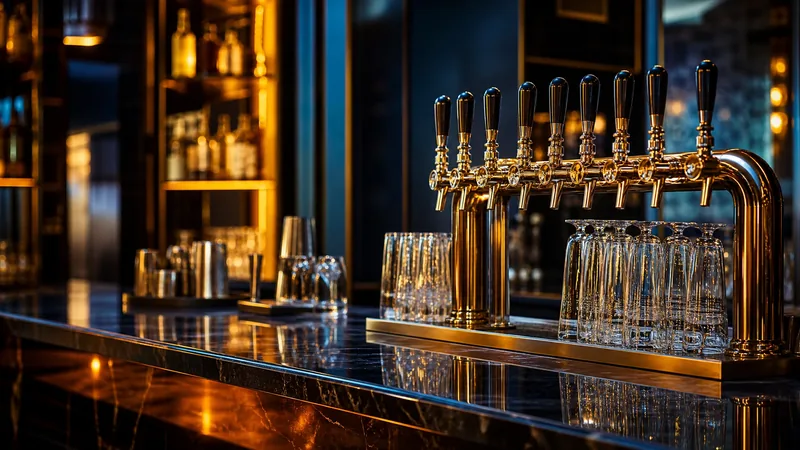
How to Start a Bar in Michigan: Quota Licenses, Local Approval and the Cost Reality
How to Start a Bar in Michigan: Quota Licenses, Local Approval and the Cost Reality
Opening a bar in Michigan depends less on paperwork than on whether a liquor license is available at all. Most on-premises bar licenses are quota licenses, which means the number available in your city, village or township is capped. Before you sign a lease, you need to know whether a license exists for your location, who has to approve it, and what the opening will really cost.
This guide covers the sequence that works for most first-time owners. It explains the license types, the local approval step, the entity and tax filings, and the fees we can verify today. Where a figure is not confirmed, we say so and name the agency you should ask.
This article is informational only. It is not legal, tax or financial advice. Liquor law and local rules change, and the Michigan Liquor Control Commission (MLCC) and your local government make the final decisions on your application. Talk with a Michigan attorney who handles liquor licensing and with a CPA before you commit money to a lease or a license purchase.
Why Michigan Geography Shapes Your Path
Michigan has 83 counties, roughly 275 to 280 cities, roughly 255 to 258 villages and 1,240 townships. Your site determines which local body must recommend your license and whether a quota license is available there at all. Cities, villages and townships each set their own zoning rules. Only 24 Michigan cities levy a city income tax, so check whether yours is one of them before you model your profit.
What You Need Before You Start
Gather these items before you contact the state or your city hall:
- A shortlist of sites with the address, the parcel's current zoning, and whether a bar or tavern use is permitted there
- The legal name you plan to use, and a resident agent with a Michigan address
- A written business plan with a 12-month operating budget covering payroll, rent, utilities, inventory and insurance
- A floor plan showing the seat count, bar area, restrooms, any kitchen, and exits
- Personal details for every owner with a financial interest, since MLCC reviews the people behind the business
- A liquor liability insurance quote
- Contact details for the city or township clerk, the zoning office and the local health department
- Working capital beyond your build-out budget, because licensing and construction usually take longer than planned
Step 1: Pick the Right License Type
Michigan's main bar categories work like this:
- Class C: the full on-premises license for spirits, beer and wine, at $600 a year. Class C is a quota license.
- Tavern: an on-premises license for beer and wine, at $250 a year. Tavern is also quota-based. Confirm with MLCC exactly what a tavern license covers before you design your menu.
- Specially Designated Merchant (SDM): a license for packaged beer and wine sold for off-premises consumption, at $100 a year. It is a retail license, not a bar license, though some owners add one for a bottle counter.
- Resort and development district licenses: special categories with their own eligibility rules, covered in Step 3.
Every license also carries a $70 nonrefundable inspection fee per license. Budget for it on every application, including any that are not approved.
Step 2: Confirm Quota Availability Before Anything Else
Quota is set by population. Each city, village or township may issue a limited number of Class C and tavern licenses based on the latest federal census. Ask the clerk of your municipality how many are authorized and how many are already issued. Then confirm the count with MLCC, because the two numbers should match. If they do not, get the difference in writing before you move forward.
A new license needs a recommendation from the local legislative body: the city council, village council or township board. The request is made on Form LCC-106. Councils often weigh the location, the surrounding neighborhood, parking and noise, as well as the applicant. Ask your clerk about any public notice or hearing requirements, and ask MLCC whether the recommendation must be on file before the state will act.
This is the step where most plans break. If the quota is full, a lease signed in advance may not produce a license at all.
Step 3: Plan for a Full Quota
When no license is available, you have four routes. Each one carries real tradeoffs.
- Buy an existing on-premises quota license. You can buy an existing on-premises quota license from a business in the same county and transfer it to your location. The state does not set purchase prices, and they vary widely. Get a written valuation from a broker or attorney, and make the purchase contingent on MLCC approval of the transfer and on local approval for your new site.
- Convert another quota class. Some other quota license classes can be converted to the class you need. Confirm the conversion rules with MLCC before you buy anything.
- Redevelopment or development district Class C. Michigan allows a Class C license tied to a qualifying district under MCL 436.1521a. It carries a $20,000 enhancement fee and requires at least $200,000 in district investment and $75,000 in building investment over five years. The development district type also requires a minimum of 25 seats. These thresholds are demanding, so test them against your real build-out budget before you choose this path.
- Resort license. A resort license is a separate category with its own eligibility rules. Ask MLCC whether your property qualifies before you plan around it.
Step 4: Form the Business Entity
Forming your entity is a filing, not a license. The Michigan Department of Licensing and Regulatory Affairs (LARA), Corporations Division, receives and files the documents that create and maintain your business. It does not license bars. Search your proposed name first on the MiBusiness Registry business search.
For an LLC, file the Articles of Organization (Form CSCL/CD-700) with a $50 filing fee. The name must include Limited Liability Company or the abbreviation L.L.C. or L.C. Michigan calls the registered agent a resident agent, and it must be a Michigan resident, a Michigan corporation or LLC, or a foreign entity authorized to transact business in Michigan. The registered office must be a physical location. A P.O. box alone will not work. The LLC files a yearly Annual Statement (Form CSCL/CD-2700) for $25, due February 15 beginning the year after formation. An LLC formed after September 30 does not owe the statement on the February 15 immediately following.
For a corporation, file the Articles of Incorporation for Profit Corporation (Form CSCL/CD-500) with a $60 filing fee. The corporation files an Annual Report (Form CSCL/CD-2500) for $25, due May 15 beginning the year after incorporation.
Two optional filings can help. A name reservation (Form CSCL/CD-540) costs $25 and holds the name for six months following the month of filing. LARA also offers expedited service through Form CSCL/CD-272, with options from $50 for 24-hour review of formation documents to $1,000 for one-hour same-day review. Plan these only if your lease or financing depends on the date.
If you will operate under a trade name, such as a bar name different from your entity name, file a Certificate of Assumed Name (Form CSCL/CD-541). An LLC files it with LARA for $25. A sole proprietor or general partnership files with the county clerk in each county where it does business instead.
Step 5: Clear Zoning, Occupancy, Building and Health
This is where local approval gets detailed, and where a license can still stall after the state approves it.
- Zoning: confirm in writing that a bar or tavern is a permitted use at your address. Some districts allow it only with a special approval, which adds a public process and time.
- Certificate of occupancy: your local building department issues this once the space meets code and passes inspection for its intended use.
- Building permits: depending on your city, permits come from the local building department or from LARA's Bureau of Construction Codes. Confirm which one applies to your project before you hire a contractor.
- Health approvals: if you serve food, your local health department will review your plans and inspect the kitchen. Ask for the plan review requirements before you buy equipment.
Build the approval calendar into your lease negotiations. A landlord who wants rent to start on signing will not wait for a council vote.
Step 6: Register for State Taxes
Michigan's state sales tax rate is 6%. Retailers must register separately with the Michigan Department of Treasury for a sales tax license. The registration is free, and it can arrive in as little as 7 business days. Register through the Treasury online business registration page. Ask Treasury how your food, beverage and merchandise sales are taxed, because the rules differ by product.
On income tax, a standard LLC is a pass-through entity, so its members report the income on their Michigan individual income tax at the flat 4.25% rate for the 2026 tax year. An LLC that elects federal C corporation treatment is subject to the 6% Michigan Corporate Income Tax. Treasury also offers a small business alternative credit with an alternate rate of 1.8% of adjusted business income. Whether it applies to your bar is a question for your CPA. If you will have employees, ask Treasury which employer registrations you need. Michigan has no franchise tax, and the LARA annual statement is the only recurring state charge from the Corporations Division.
Step 7: File the MLCC Application
Once you have a local recommendation and a secured site, file with MLCC. The application fees you must budget for are $600 a year for Class C, $250 a year for tavern, and the $70 nonrefundable inspection fee per license. Ask MLCC for current processing times and the full application packet. Do not sign a lease with rent starting before you know when the state decision is likely to arrive, and never assume a date from a neighbor's experience.
Step 8: Buy Liquor Liability Insurance
Michigan's dram shop liability rules under MCL 436.1801 apply when a licensee serves a visibly intoxicated person or a minor. That exposure is the core reason liquor liability insurance matters. Get at least three quotes from an agent who writes liquor liability policies. Compare the limits, exclusions and how claims are handled, not just the premium. Train every server to check identification and refuse service to visibly intoxicated guests, because staff habits are what create or prevent that exposure.
The Cost Reality
The table below lists only the fees verified for this guide. It is not a complete startup budget.
| Item | Amount | Agency or source | Recurring? |
|---|---|---|---|
| Articles of Organization (LLC) | $50 | LARA | One time |
| Articles of Incorporation (corporation) | $60 | LARA | One time |
| Name reservation (optional) | $25 | LARA | One time, holds six months |
| Assumed name (LLC) | $25 | LARA | Renewable |
| LLC Annual Statement | $25 | LARA | Yearly, due February 15 |
| Corporation Annual Report | $25 | LARA | Yearly, due May 15 |
| Sales tax registration | Free | Treasury | One time |
| Class C license fee | $600 | MLCC | Yearly |
| Tavern license fee | $250 | MLCC | Yearly |
| Specially Designated Merchant fee | $100 | MLCC | Yearly |
| Inspection fee per license | $70 | MLCC | Nonrefundable |
| Development district enhancement fee | $20,000 | MLCC | One time, if applicable |
| Quota license purchase price | Not set by the state. Get a broker or attorney valuation. | Private market | One time |
| Build-out, lease, equipment, inventory, payroll and insurance | Not set by the state. Get written quotes. | Private market | Varies |
For an LLC applying for a Class C license at formation, the verified state charges come to $720: the $50 articles fee, the $600 annual license fee and the $70 inspection fee. That figure leaves out the optional filings, the first annual statement and every private cost. Rent, build-out, equipment, inventory, insurance and any quota purchase will be far larger. Treat $720 as the cost of the paperwork, not the cost of the bar.
Common Mistakes to Avoid
- Signing a lease first. Confirm quota, zoning and the local recommendation path before you commit to a site.
- Assuming LARA issues the liquor license. LARA files your entity. MLCC licenses the sale of alcohol.
- Using a P.O. box as the registered office. The resident agent's registered office must be a physical location.
- Missing the annual filings. The LLC Annual Statement is due February 15 each year, and the corporation's Annual Report is due May 15.
- Buying a quota license without transfer approval. Make the purchase contingent on MLCC and local approvals for your site.
- Ignoring city income tax. Only 24 cities levy one, but if yours does, it belongs in your model.
- Underbudgeting for delays. Plan for the $70 inspection fee on every application and for the possibility that a council vote or a permit takes longer than you hoped.
- Treating insurance as an afterthought. Dram shop exposure is the risk that matters most in a bar, so quote it early.
What Results to Expect
A careful application can help you avoid the delays that catch most first-time owners, such as a missing quota, a zoning gap or an incomplete local recommendation. It cannot guarantee an approval date, a license outcome or a sales volume. Those depend on your location, menu, staffing, competition and local rules. Treat any revenue projection as a planning estimate, and test it with your CPA and an attorney before you borrow money or sign a long lease.
Official Resources
- LARA Corporations Division: entity forms, fees and filing guidance
- MiBusiness Registry Portal: online filing and name search
- Michigan Department of Treasury: state tax rules and registration
- Michigan Small Business Development Center: free planning help for new owners
- SBA Michigan District: federal small business resources for Michigan
For MLCC licensing questions, search michigan.gov for the Liquor Control Commission and confirm current forms and fees there before you file. Because this process combines state, county and local decisions, a Michigan attorney who handles liquor licensing and a CPA are worth the cost before you commit.
Reminder: this article is informational content, not legal or tax advice. Verify every fee, deadline and requirement with the agency named before you act.
Keep exploring: related Michigan guides
- How to Start a Bakery Business in Michigan
- How to Start a Catering Business in Michigan
- How to Start a Winery or Cidery in Michigan
- How to Start a Coffee Shop Business in Michigan
- Michigan Liquor License
- How to Start an LLC in Michigan
- Michigan Business License
- How Much Does It Cost to Start a Business in Michigan
- All Michigan business types
- Every Michigan guide in one place